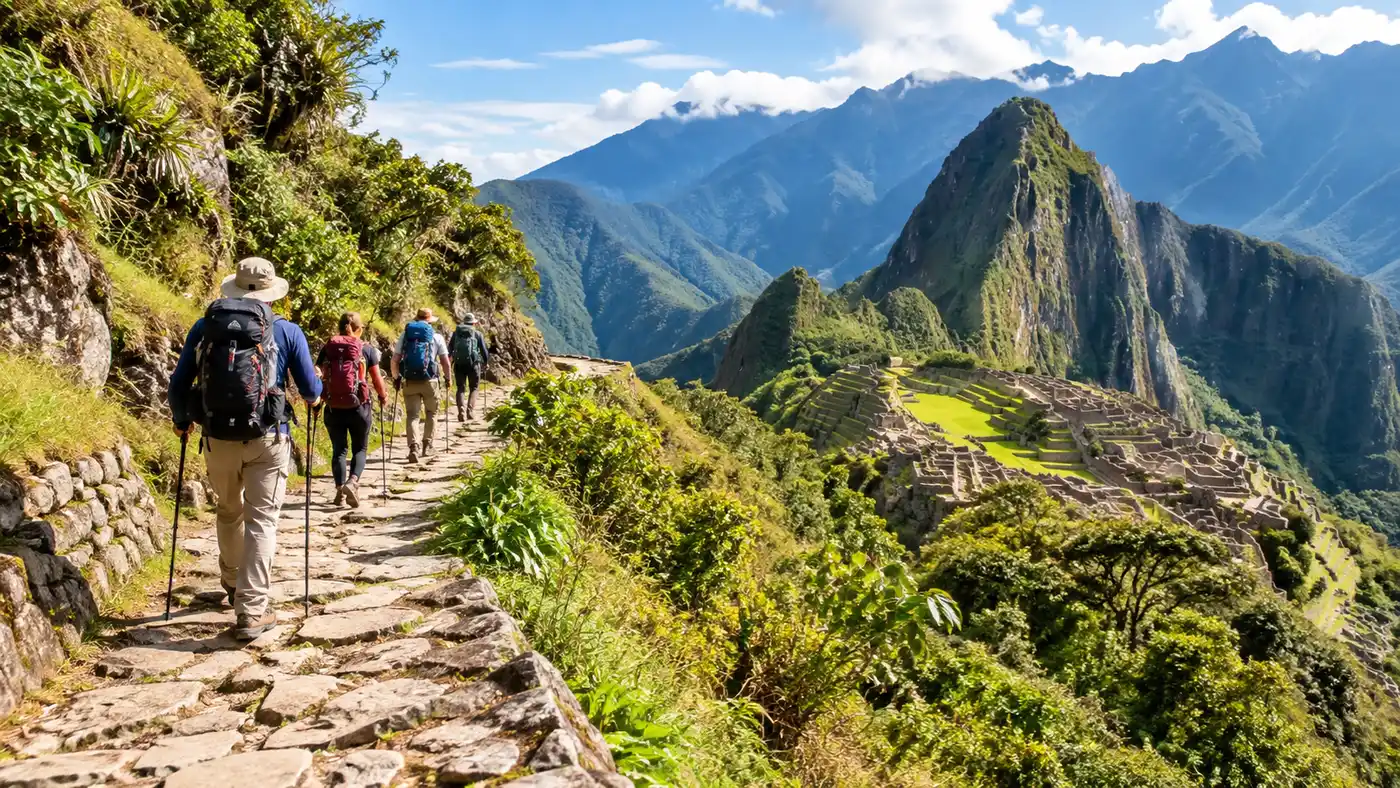
How Long Is the Inca Trail Hike
If you ask a mapmaker how long is the inca trail trek, they will give you a neat number: exactly 42 kilometers, or roughly 26 miles. That sounds like a long Saturday run across rolling parkland, but the map leaves out the vertical stairs carved into sheer Andean granite. Out here, distance does not behave the way you expect. You spend four days moving at a snail's pace, breathing air thin enough to make your teeth tingle, while porters in sandals jog past carrying 20-kilo packs.
Understanding the true length of this trek means looking at two separate measurements: physical distance and trail time. A six-mile stretch on Day 2 will easily take you seven hours, whereas on flat asphalt back home, you might knock that out before breakfast. Before booking flights to Cusco, you need to know how those miles translate into daily hours, quad-burning descents, and nights shivering in a canvas tent.
Book your cusco inca trail experience:
Total Inca Trail Distance: Miles, Kilometers, and Days
The standard route begins at a dusty railroad checkpoint called Kilometer 82, just outside the village of Ollantaytambo. From that swaying suspension bridge over the Urubamba River to the stone archway at the Sun Gate, the official classic inca trail length measures 42 kilometers. In Imperial units, that puts the inca trail distance right at 26 miles. Most trekking agencies spread this route across four days and three nights, which gives an average of roughly 6.5 miles per day.
That daily mileage sounds easy on paper. Hikers who glance at the numbers often assume the hike will feel like a leisurely walk through the countryside with plenty of time for afternoon naps. The reality hits hard around midday on the first push up the valley. The inca trail hike length feels double its measured distance because you rarely take a flat stride. You are either stepping up granite blocks or jamming your walking poles into dirt to brake on the way down.
For travelers who cannot commit to four full days sleeping in freezing valleys, a shorter alternative exists. The short trail begins further down the train line at Kilometer 104. This trimmed version covers roughly 12 kilometers (about 7.5 miles) of walking before meeting up with the classic path at the ruins of Wiñay Wayna. If you are comparing routes, looking at a classic Inca Trail 4 days itinerary will show you how radically different the pacing is compared to the two-day sprint.
Here is how the four classic days break down in distance, walking hours, and elevation change:
| Day | Distance (km / miles) | Typical Hiking Time | Key Elevation Points |
|---|---|---|---|
| Day 1 | 12 km / 7.5 miles | 5 to 6 hours | 2,600m to 3,000m (gentle gain) |
| Day 2 | 11 km / 6.8 miles | 6 to 8 hours | 3,000m to 4,215m pass, down to 3,600m |
| Day 3 | 16 km / 9.9 miles | 7 to 9 hours | Passes at 3,950m and 3,650m, down to 2,650m |
| Day 4 | 5 km / 3.1 miles | 2 to 3 hours | Flat push to Inti Punku (2,720m) and Machu Picchu |
Note: Campsite assignments are controlled strictly by the Peruvian Ministry of Culture when permits are issued. Your specific daily mileage may shift by 2 to 3 kilometers depending on whether your operator camps at Wayllabamba or Ayapata on night one, or Chaquicocha versus Phuyupatamarca on night two.
Day-by-Day Breakdown: How Long Does It Take to Walk the Inca Trail?
Day 1 is designed to ease your lungs into the task. You leave Ollantaytambo early, clear the passport control desk at Kilometer 82, and follow the rolling contour beside the river. The path climbs gently through dry scrub forest full of flowering cacti. You pass the terraces of Patallacta below you on your left, looking like concentric ripples frozen in the dirt. Most groups walk roughly 12 kilometers to either Wayllabamba or the slightly higher camp at Ayapata. It takes about five hours of relaxed moving, broken up by an enormous hot lunch prepared inside a mess tent.
Day 2 changes the mood entirely. This is the stretch that makes people question their life choices. From camp, you begin an unrelenting vertical climb toward Warmiwañusqa, better known as Dead Woman's Pass. The distance is short, barely 7 miles, but the path climbs nearly 1,200 vertical meters through thinning dwarf forest and into the alpine tundra. You take ten steps, stop, lean heavily against your trekking poles, and wait for your pulse to drop below 150 beats per minute. Reaching the pass takes roughly four hours of steady ascending, followed by two agonizing hours descending steep stone steps to the Pacaymayo valley camp.
Day 3 covers the greatest distance of the entire journey. You cover nearly 10 miles, crossing two distinct high passes before dropping into the sub-tropical cloud forest. While Day 2 owns the reputation for pure exhaustion, Day 3 is the hardest test for your joints. You descend thousands of wet Inca stairs carved straight into the rock face. The scenery softens into green moss, wild orchids, and bamboo groves, with ruins like Sayacmarca clinging to sheer cliffs beside the path. Most hikers spend around eight hours on their feet before tumbling into the Wiñay Wayna camp in the late afternoon.
Day 4 is the reward. The camp wakes up in pitch darkness around 3:30 in the morning. After waiting for the park ranger gate to swing open at 5:30 am, you have just 5 kilometers left to hike. The path here is relatively flat, winding through lush foliage until you reach the infamous "gringo killer" staircase, a nearly vertical pitch of 50 stone steps that requires hands and feet. At the top sits Inti Punku, the Sun Gate. From there, you get your first view of the stone citadel sitting on the green ridge below. The final stroll down into the sanctuary takes roughly 45 minutes.
How High Is the Inca Trail: Altitude and Elevation Gain
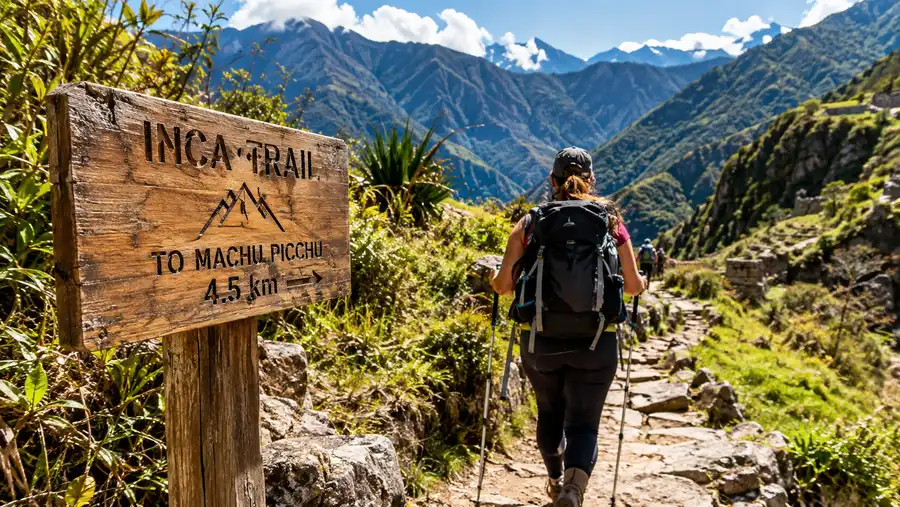
You cannot talk honestly about how long is the inca trail to machu picchu without factoring in the sky. If this exact trail sat at sea level, active hikers could crush the entire distance in two easy days. The invisible barrier is the thin air. The trail starts at roughly 2,600 meters (8,530 feet) above sea level at the river crossing. By the afternoon of your second day, you stand atop Dead Woman's Pass at 4,215 meters (13,828 feet).
At that elevation, each breath draws in roughly 40 percent fewer oxygen molecules than you get on the coast. Your legs feel like lead pipe. A small hill that you would normally jog up becomes an arduous five-minute enterprise. The total cumulative elevation gain across the four-day trek runs somewhere between 2,500 and 3,000 vertical meters, with an almost identical amount of punishing descent. The descent is what ruins knees, especially on wet stone polished by centuries of sandals and rubber vibram soles.
Understanding the highest altitude on the trail helps you structure your preparation. Acclimatization is not something you can rush by sheer willpower. Spend at least two full calendar days wandering around Cusco or the Sacred Valley before you step up to Kilometer 82. Drink muña tea, sip water constantly, and skip the heavy steaks on your first night in town. If altitude sickness strikes halfway up Day 2, the hours you spend walking will stretch into an exhausting blur.
Pro tip: Rent or buy two sturdy trekking poles with rubber tips before leaving Cusco. Downhill stone steps on Days 2 and 3 put massive shock loads on your patellar tendons, and poles transfer roughly twenty percent of that weight into your shoulders.
Book your cusco inca trail experience:
Alternative Route Lengths: How Long Is the Hike to Machu Picchu?
The four-day classic is not the only way to walk into the ruins. Depending on your schedule, endurance, and willingness to sleep on foam mats, the inca trail hike length shifts depending on the specific route permit you purchase.
- Short Inca Trail (2 Days): 12 kilometers total walking. You take the train to Kilometer 104, hike past Chachabamba and Wiñay Wayna, and arrive at the Sun Gate in the afternoon of Day 1. You sleep in an Aguas Calientes hotel and tour the main ruins the following morning.
- Classic Inca Trail (4 Days): 42 kilometers across three mountain passes. This is the traditional pilgrimage route involving three nights of wilderness camping under canvas tents.
- Slow-Paced Inca Trail (5 Days): 42 to 45 kilometers using the classic route. It covers the exact same geography as the 4-day option but divides the Day 3 push into two smaller chunks, making it ideal for families or photographers who want unhurried mornings.
- Salkantay / Classic Combo (6 to 7 Days): Roughly 70 kilometers. This rugged combination tackles the high glacial pass of Mount Salkantay before cutting across high alpine passes to connect with the final stone sections of the original royal road.
For most people asking how long is inca trail hike, the four-day trek remains the benchmark. It provides enough time to disconnect from modern noise without turning into a grueling survival test. The two-day version works wonders if you have small kids or bad knees, but you miss out on the wild solitude of the high alpine camps where the night skies look like spilled diamond dust.
Pacing, Walking Speed, and Daily Trail Routine
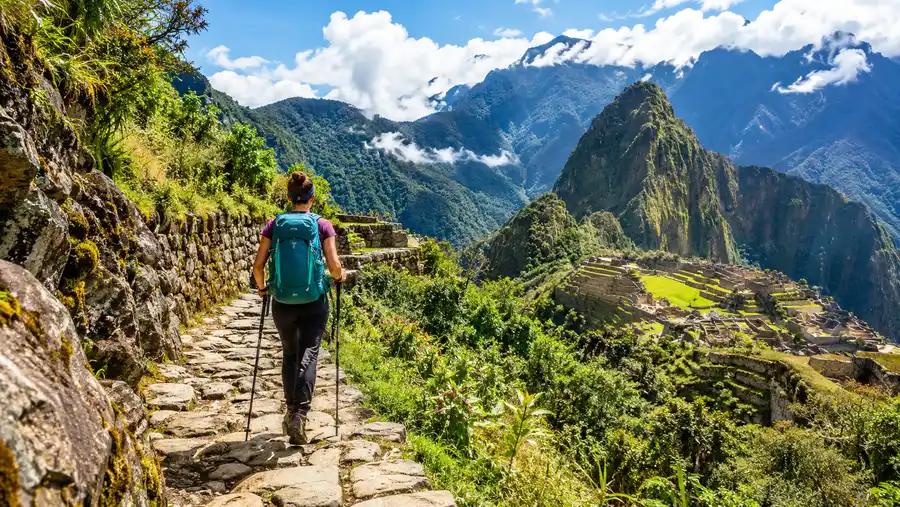
A typical day on the path starts earlier than most vacations. Porters will gently tap on your tent wall around 4:45 am, whispering offers of hot coca tea or boiled water for your wash basin. By 5:45 am, your duffel bag must be packed and handed over to the crew, your boots laced, and your stomach full of oatmeal or fried plantains. You start walking before the sun clears the eastern ridges.
The pace is surprisingly social. Unless you hire a private guide, you will hike with a small group of six to ten people. Everyone walks at their own natural cadence during the climbs, regrouping at scenic vistas or trail junctions. Guides hang back with the slowest walker, so you never have to worry about getting abandoned in the cloud forest. A fast hiker might cover three kilometers of uphill terrain in an hour; at high altitude, you should expect to cover just one to two kilometers per hour on the ascents.
- Morning push: Usually 3 to 4 hours of steady movement before reaching the designated lunch stop, where the camp crew has already erected a dining shelter and cooked a multi-course hot meal.
- Midday siesta: Around 45 to 60 minutes spent resting out of the midday heat, stretching calves, and refilling hydration bladders with boiled, cooled water.
- Afternoon stretch: Another 2 to 3 hours of trail time, usually dropping down toward the evening campsite as the Andean fog starts rolling over the mountain ridges.
- Camp arrival: Typically between 4:30 pm and 5:30 pm. You change out of sweaty hiking clothes immediately, before the valley temperature plunges into single digits.
The beauty of this forced routine is that time stops being about minutes and hours. You measure the day by the ridge ahead of you, the smell of damp eucalyptus leaves, and the cold taste of clean water. By eight o'clock each night, camp is completely silent except for the wind whipping off the glaciers.
Frequently Asked Questions about how long is the inca trail trek
How many miles do you walk a day on the Inca Trail?
On the standard four-day trek, you cover an average of 6.5 miles per day. However, the days are unequal. Day 4 requires only about 3 miles of walking, while Day 3 demands nearly 10 miles across rocky, uneven mountain stairs.
Can a beginner handle the length of the Inca Trail?
Yes, provided you have a reasonable baseline of aerobic fitness and prepare your legs ahead of time. The secret is pacing yourself slowly on the stairs and giving yourself two to three days in Cusco beforehand to adapt to the thin air.
How many hours a day are you actually hiking?
Most hikers spend between five and eight hours on the path each day. The longest day is usually Day 3, where walking, taking photos at ancient stone ruins, and stopping for lunch can stretch the total trail time to nine hours.
Is the trail open year-round?
No. The trail closes every year for the entire month of February for conservation, safety maintenance, and heavy wet-season trail repairs. It remains open the other eleven months of the year, though permits sell out months ahead.
Quick Reference
- Total distance: 42 km (26 miles)
- Standard duration: 4 days / 3 nights
- Highest pass: 4,215 m (13,828 ft)
- Average daily hiking: 6 to 7 hours
- Starting point: Km 82 (Piscacucho)
Book your cusco inca trail experience:
The Bottom Line
When you stand at the Sun Gate on that final misty morning, the raw numbers fade into meaningless trivia. You will not care whether the path was 42 kilometers or 50, or that you climbed roughly 3,000 vertical meters over jagged granite slabs. What stays with you is the physical memory of earning your first glimpse of the ancient sanctuary through sweat, patience, and one rhythmic boot-step after another. Take your time, train your legs on whatever stairs you can find at home, and do not rush the walk; the path itself is the entire point.
Read more about cusco inca trail.