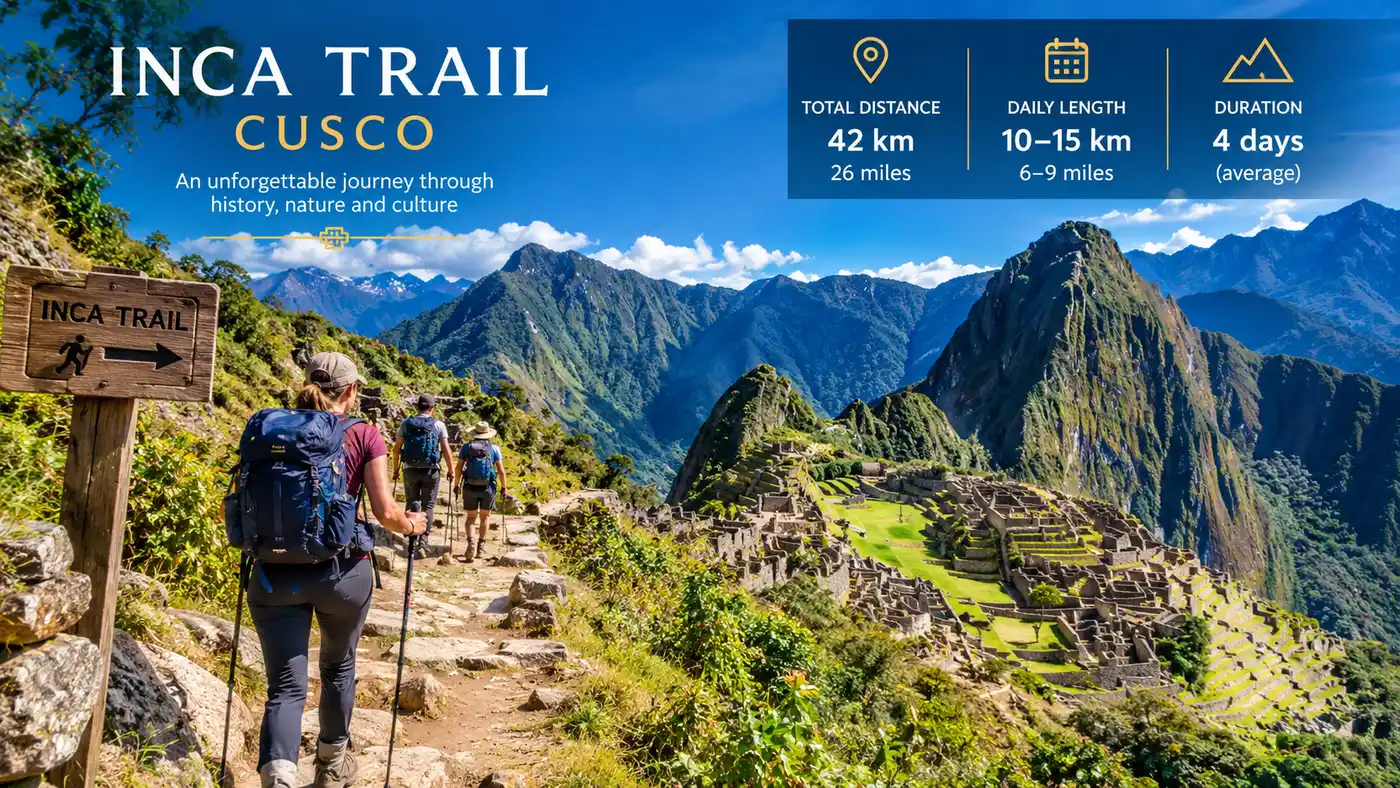
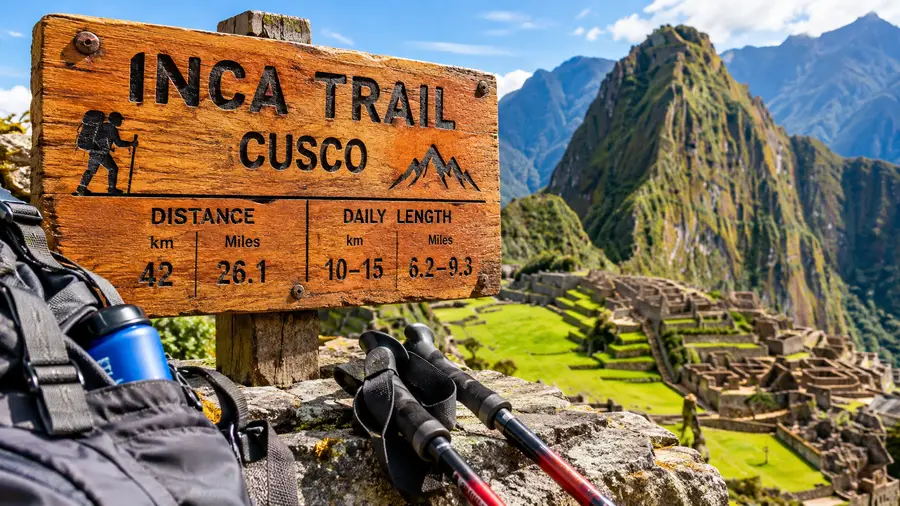
Inca Trail Distance km Miles Daily Length
When people plan this trek, they obsess over the total inca trail miles, but looking at a flat distance map will fool you. On paper, the classic route covers roughly 26 miles from the checkpoint at kilometer 82 to the stone gateway above Machu Picchu. That sounds like a long marathon walk over four days. You might think you can easily knock out six or seven miles before lunch and spend your afternoons relaxing in a hammock.
The Andes do not care about flat miles. A single mile climbing straight up ancient granite staircases at 12,000 feet takes three times as long as a mile along a riverbed, and it will tear up your quadriceps in ways you did not anticipate. Understanding how the distance breaks down day by day is the best way to prepare your knees, pack the right gear, and pace yourself so you actually enjoy arriving at the ruins.
Measuring Inca Trail Miles Versus Andean Vertical Steps
The total inca trail length sits right around 42 kilometers, which converts to approximately 26 miles. Tour operators sometimes quote slightly different numbers, ranging from 24 to 27 miles, depending on where your specific crew camps each evening. If your agency pushes past the crowded village of Wayllabamba on the first evening to sleep higher up at Ayapata, your first day gets longer while your second day becomes slightly more manageable.
Measuring mountain terrain in pure horizontal distance is honestly pretty useless here. A seven-mile day in the high Andes can take eight exhausting hours of heavy breathing, while a seven-mile walk across a flat valley in the Sacred Valley might take you less than three. The physical toll comes from the relentless changes in gradient. You are walking along roads laid out by 15th-century stonemasons who did not bother designing switchbacks for pack mules. They built direct stone stairs straight up ridges because royal messengers ran barefoot along these trails.
If you want to know how long is the inca trail in terms of effort, think of it as climbing hundreds of flights of uneven stone stairs while carrying a ten-pound daypack with twenty percent less oxygen entering your lungs. Some steps are ankle-high, others require you to haul your knee up toward your chest. That vertical reality changes how those 26 miles feel under your boots.
Pro tip: Do not pace your walking speed against a GPS watch or fitness tracker. Track your breathing rate instead, keeping your cadence slow enough that you can inhale through your nose on the brutal climbs.
Book your cusco inca trail experience:
Day by Day Inca Trail Miles and Elevation Breakdown
The trek is broken into four distinct days, each with its own personality, weather pattern, and physical demand. Most trekkers find that the shortest day in terms of horizontal mileage ends up being the hardest day of their entire life. To help you wrap your head around the profile, here is the day-by-day breakdown of the journey.
| Day | Route Segment | Distance (Miles / Km) | Elevation Gain / Loss | Hiking Time |
|---|---|---|---|---|
| Day 1 | KM 82 (Piscacucho) to Wayllabamba or Ayapata | 7.5 to 8.7 miles / 12 to 14 km | +1,150 ft / -200 ft | 5 to 6 hours |
| Day 2 | Wayllabamba to Pacaymayo via Dead Woman's Pass | 6.8 to 7.5 miles / 11 to 12 km | +3,900 ft / -2,300 ft | 6 to 8 hours |
| Day 3 | Pacaymayo to Wiñay Wayna via Runkurakay | 9.3 to 10 miles / 15 to 16 km | +2,700 ft / -3,800 ft | 8 to 9 hours |
| Day 4 | Wiñay Wayna to Inti Punku and Machu Picchu | 3.1 miles / 5 km | +150 ft / -950 ft | 2 to 3 hours |
Day one eases you into the rhythm. You start at Piscacucho, right by the train tracks at kilometer 82, at an altitude of roughly 8,850 feet. The trail follows the Urubamba River through scrubby cactus forests and rolling terrain that locals call "Inca flat" - meaning it rolls up and down constantly without ever staying level. You pass small settlements where local families sell bottles of warm Gatorade and water. By the time you reach camp, your legs will feel warmed up and ready for what lies ahead.
Day two is where the trail tests your resolve. The inca trail elevation gain by day peaks sharply here. You leave the tree line behind, grinding upward through wet alpine grassland called the puna. Your goal is Warmiwañusqa, or Dead Woman's Pass, standing at 13,828 feet above sea level. Reaching the pass takes about four to five hours of continuous climbing. Once you touch the windy pass, you drop immediately down thousands of steep, slippery rock steps into the Pacaymayo valley to sleep.
Day three covers the longest inca trail distance of the whole trek, hovering around ten miles. It is also the most stunning day. You climb up to a second pass at Runkurakay, navigate narrow stone pathways carved straight into granite cliffs, and plunge down through lush cloud forest dripping with moss and wild orchids. The ruins of Sayacmarca and Phuyupatamarca appear out of the mountain mist like phantom stone fortresses. Your knees take a beating descending nearly 4,000 feet of damp stairs to Wiñay Wayna.
Day four is a short victory sprint. You wake up around 3:30 in the morning, wait for the trail checkpoint to open at 5:30 am, and power through about three miles of undulating cloud forest trail. You scramble up the famous "gringo killer" stairs - where you use your hands to crawl up fifty nearly vertical stone rungs - and suddenly emerge through Inti Punku, the Sun Gate, staring down at the citadel of Machu Picchu below.
Understanding Inca Trail Elevation Gain and Step Counts
The total length of inca trail does not communicate how much work your knees do. If you wear a step counter, expect to log somewhere between 65,000 and 85,000 steps over the four days. A significant portion of those steps are taken while descending slick, hand-carved stone steps worn smooth by centuries of rain and rubber soles.
Going up gets all the drama because your lungs burn and your heart pounds in your ears. You stop every twenty paces, pretend to admire a yellow orchid or take a photo of a llama, and try to catch your breath. The descent, though, is what really injures people. Dropping from the second pass down to the valley camp means hours of high-impact pounding on cold joints. If you have any underlying knee issues, the downhills will expose them quickly.
The cumulative climbing across the trek exceeds 9,000 vertical feet, with an almost equal amount of descent. You can review the full breakdown of climbs in our detailed look at inca trail elevation gain explained, which helps you plan training blocks at home. Knowing that you must descend thousands of feet after exhausting yourself on an uphill pass helps you save energy instead of sprinting to the summit for a quick photo.
Note: Trekking poles with rubber tips are mandatory on the Inca Trail to protect the original stone paving. Metal spikes are confiscated at the KM 82 checkpoint by park rangers.
Book your cusco inca trail experience:
Terrain Differences Across the Inca Trail Length
Walking the trail is not like walking a maintained national park gravel path back home. The surface changes under your feet every couple of miles, requiring different footwork and muscle balance throughout the day.
- Packed dirt and river stones: Common on the first morning along the Urubamba valley, generally dry and easy to walk on, though dusty in June and July.
- Granite Inca steps: Irregular, massive hand-cut blocks that form the staircases over the high passes, frequently wet from mountain fog.
- Cloud forest flagstones: Mossy rock pathways winding through jungle canopies, often slick with humidity and dripping ferns.
- Cliffside tunnels: Narrow sections where the Incas chiseled walkable grooves straight into the living cliffside, bordered by sheer drop-offs.
Because the terrain shifts so unpredictably, how long is inca trail in hours depends heavily on the weather. A rainy afternoon on day three can add an hour and a half to your walking time because everyone slows down to avoid slipping off wet stone edges. You have to focus on where your boot lands on every single stride, which creates mental fatigue alongside the physical burn.
Short Inca Trail Distance vs Classic 4-Day Route
Not everyone has four days to spare or the desire to camp in cold mountain tents for three nights. A popular alternative is the two-day short Inca Trail, which cuts the physical distance down considerably while still giving you the experience of walking through the Sun Gate on foot.
This shorter route starts from the train tracks at kilometer 104, located much further down the Urubamba gorge. From KM 104, you hike about 7.5 miles (12 kilometers) uphill past the spectacular agricultural terraces of Chachabamba and Wiñay Wayna. You join the final stretch of the classic path, pass through Inti Punku late in the afternoon when the big crowds have already gone back to Cusco, and descend to Aguas Calientes to sleep in a warm hotel bed.
Comparing the two options comes down to what you want out of the Andes. If you want the deep wilderness immersion, the cold starry nights at 12,000 feet, and the badge of honor that comes with clearing Dead Woman's Pass, the classic route is unmatched. If you are traveling with young kids, have bad knees, or only have a week of vacation, the one-day hiking distance of the short trail gives you the best ruins without the brutal multi-day grind.
Daily Pacing Tips for Trekking High Mountain Miles
Pacing on the Inca Trail requires throwing your usual road-running or neighborhood walking habits out the window. If you try to hold a three-mile-per-hour pace uphill at 11,000 feet, you will run out of energy within twenty minutes and spend the rest of the morning fighting a pounding altitude headache.
- The mountain shuffle: Shorten your stride length until your steps are barely half the width of your normal gait on steep stairs.
- Rest breaks: Take short, thirty-second standing breathers every ten minutes rather than sitting down for fifteen minutes, which allows your legs to stiffen up.
- Hydration checkpoints: Drink water on a schedule rather than waiting until you feel thirsty, sipping at least three liters daily across the trail miles.
- Layer management: Strip off your heavy fleece the minute you start moving in the morning; sweating through your base layers will leave you shivering the second you pause.
Most guided groups operate with porters running ahead to set up tents and cook hot lunches. That means you are not carrying your sleeping bag or heavy tent, which frees you to walk light. Keep your daypack under twelve pounds if possible. A water bladder, rain jacket, sunscreen, blister tape, and a few snacks are all you really need between the designated meal spots.
Frequently Asked Questions about inca trail miles
How many total miles is the classic Inca Trail hike?
The classic Inca Trail spans roughly 26 miles (42 kilometers) over four days. Depending on the exact campsites your trekking company reserves, daily distances vary from 3 miles on the final morning to roughly 10 miles on the long third day.
Which day of the Inca Trail is the hardest?
Day two is universally considered the most difficult day. Even though it is only about seven miles long, you must climb nearly 4,000 vertical feet to clear Warmiwañusqa (Dead Woman's Pass) at 13,828 feet, followed by a steep descent down thousands of stone steps.
How many miles do you hike on day four to reach Machu Picchu?
The final day is the shortest, covering just about 3.1 miles (5 kilometers) from the Wiñay Wayna campsite to the Sun Gate and down into the ruins of Machu Picchu. Most hikers finish this segment in about two to two and a half hours.
Quick Reference
- Total distance: 26 miles (42 kilometers)
- Highest elevation: 13,828 feet (4,215 meters) at Dead Woman's Pass
- Daily hiking time: 5 to 9 hours
- Hardest stretch: Day 2 pass climb (4,000 vertical feet)
Book your cusco inca trail experience:
My Take on the Mileage
Whenever someone asks me about the trail, I always tell them to stop worrying about the 26-mile total. In the flat world, 26 miles is a weekend walk in a state park. In the Peruvian Andes, it is a four-day physical pilgrimage that will test your patience, your joints, and your lung capacity in ways you will talk about for decades. Do your step training, break in your leather boots months before you fly to Peru, take the acclimatization days in Cusco seriously, and respect the vertical profile of the Andes. The view from the Sun Gate at dawn makes every single stone step worth the ache.
Read more about cusco inca trail.